
Open shelving has a way of completely changing a room. It can make a space feel lighter and put everyday items conveniently within reach. It can showcase collections and conversation starters. It can also solve design problems that a conventional cabinet can’t.

However, there’s an important distinction between loving the idea of open shelving and loving living with open shelving!!
That distinction is worth exploring because open shelving isn’t inherently practical or impractical. Its usefulness changes depending on where it is and what you put on it…but instead of going room-by-room with “thou shalt” and “thou shalt not” dogmas, let’s look at this simple equation:
Right location + right things + right frequency of use = useful open shelving
Change any part of that equation, and open shelving is no longer worth your while. That’s not an argument against open shelving. In fact, it’s an argument for being more creative with it!
So, before deciding where open shelving belongs in your home (or whether it belongs there at all), there are a handful of practical questions worth considering. These are the questions that turn open shelving from something that looks trendy into something that actually works for the way you live…
Let’s begin!!
Q: What will live on the shelves?
This sounds obvious, but open shelving is often designed in the wrong (and opposite) order. This is what people tend to do: find an inspiring photo, decide where shelves would look good, and then figure out what to put on them.
For open shelving that actually earns its place in your home, however, you should reverse that process. The items you store in open shelving will ultimately require different shelf depths, spacing, materials, locations and amounts of support based on what those items include.
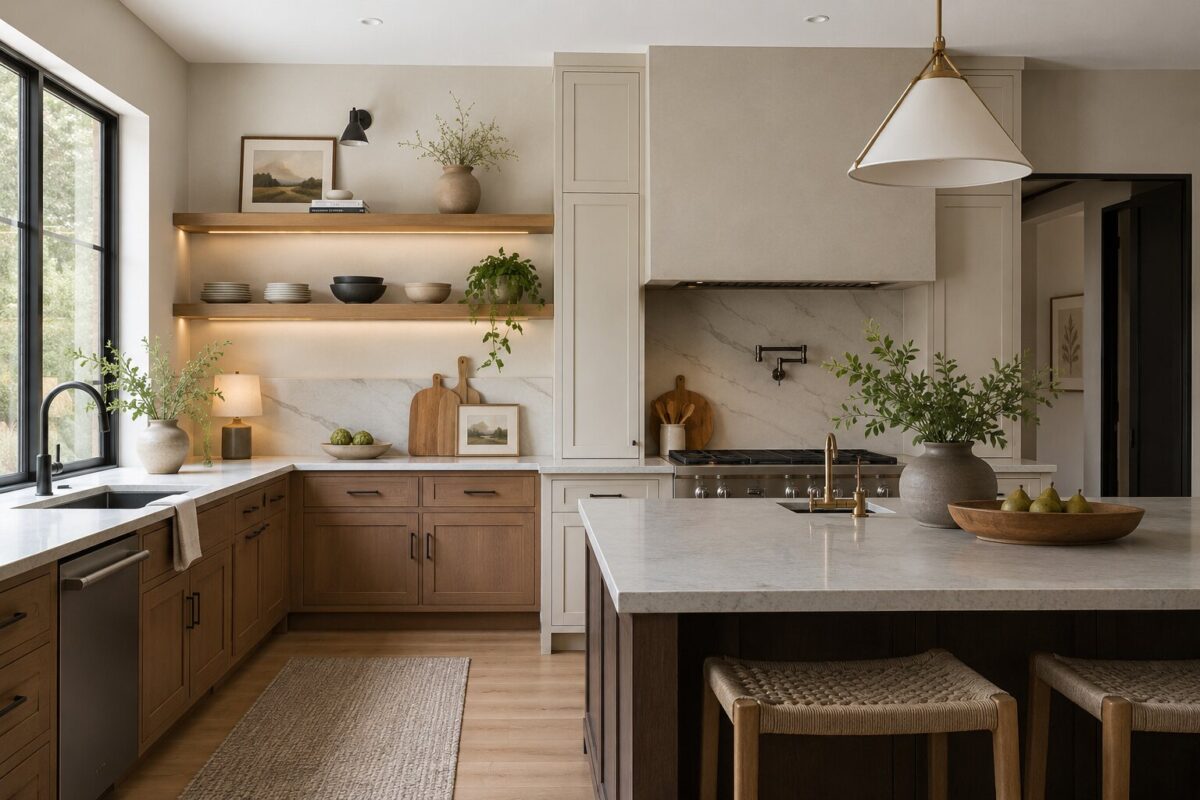
So, before designing your dream shelves, make a list of EXACTLY what you expect to put on them. Better yet, gather those things together on a table! How much space do they occupy? Are they things you want to see every day? If the collection makes you think, Yes, I would love having these out, then you’re really starting to get somewhere!!
Q: How frequently will you use what’s there?
Some open shelving is decorative, while some is made for day-to-day practicality. So there’s no right or wrong answer here! But you DO have to ask this question first as part of your overall shelving placement and design.
For instance, everyday dishes on an accessible kitchen shelf will never have time to collect dust because they’ll constantly be coming down, being washed, and going back up.
Frequency also changes the value of convenience. Eliminating a cabinet door between you and something you reach for five times a day will improve the way the room works MUCH more than doing the same thing for an item you use once a week.
For your own frequency test, divide the proposed contents for your open shelf into four categories:
- Daily: Strong candidate for accessible open storage.
- Weekly: Still likely to benefit from easy access.
- Occasionally: Consider whether display value justifies having it exposed.
- Rarely: Protected, closed storage could serve it better.
How many of the items fall into each category?
Q: Can you actually reach and use the shelf comfortably?
A shelf can provide storage and still be remarkably inconvenient storage.
So ask yourself: can you comfortably reach everything on the shelf? Can you see everything that’s there? Can you get an object down without moving three other things first? Can you return it just as easily?
This becomes particularly important with:
- Heavy objects
- Fragile pieces
- Deep shelves
- Tall shelving arrangements
- And anything positioned above shoulder height
Accessibility is also personal. The right height for one member of a household could be completely impractical for another…
Q: How much dust, grease and cleaning are you signing up for?
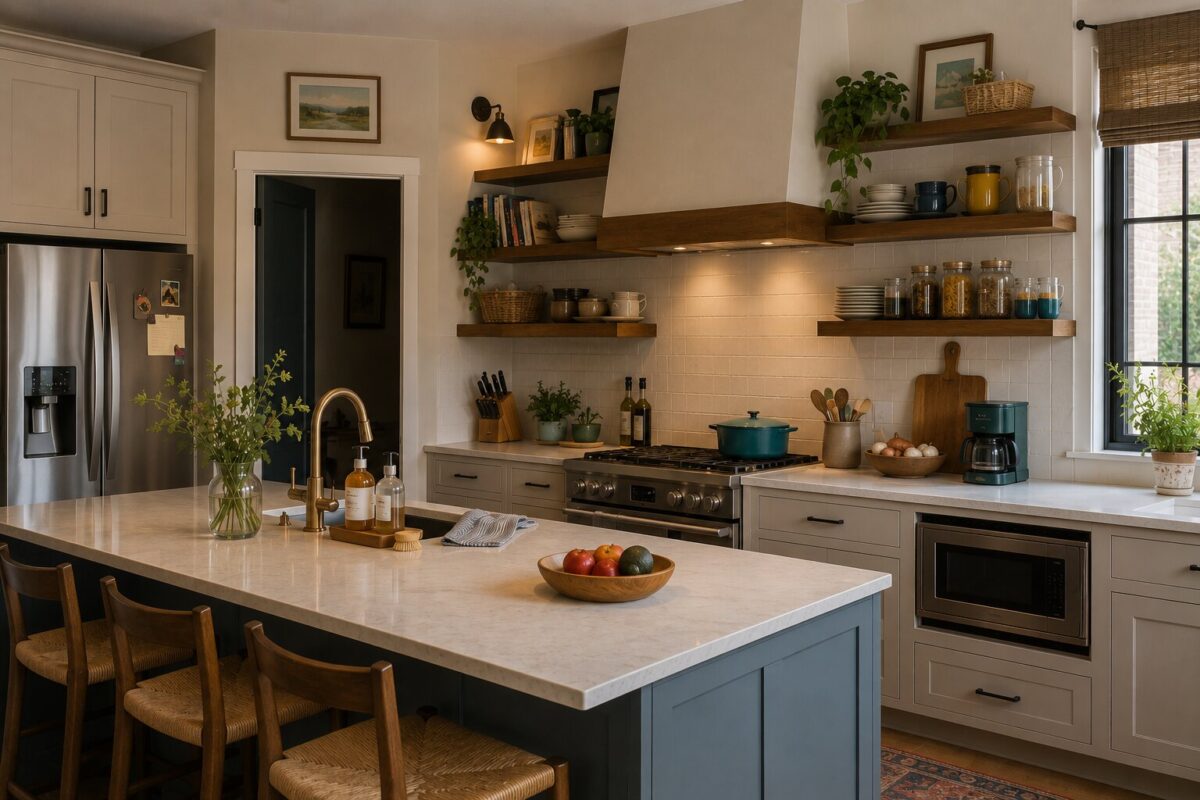
Dust is a consideration anywhere in the home, but kitchens in particular add moisture, steam, airborne grease and cooking residue. That’s why the exact same open shelf can be practical in one location and frustrating in another.
Proximity to your cooktop deserves particular attention. Shelving near cooking activity requires constant cleaning (and not only of the shelf itself, but of everything sitting on it).
Materials matter here, too!! A smooth, easily cleaned surfacew behaves differently from a highly textured or porous one…
Q: How tidy is your whole household?
Yes, this matters!!
Open shelving turns storage into something you see. Something EVERYONE sees. And for some households, that’s an advantage because things naturally go back where they belong, and seeing frequently used objects makes the room feel welcoming and lived in.
(Hello, home design for families with children…)
For other households, the ability to close a cabinet door is one of civilization’s greatest achievements!!
Neither household is doing it wrong. But you need to know who you are.
Which brings me to…
Q: Are you designing for yourself, or for a photograph?
Staged open shelving photographs beautifully.
But photographs don’t have to make breakfast!!
The shelves we see in beautifully styled rooms have been arranged for the image: a few matching dishes, carefully spaced pottery, a plant, perhaps a cookbook leaning at exactly the right angle…but these don’t show the children’s cups, your protein shaker, the dog treats, and the 14 mismatched coffee mugs.
Your home doesn’t have to look camera-ready to be beautiful, though!
Try this “Wednesday-morning” test:
Forget the finished-room photograph. Picture YOUR space with open shelves at 7:30 on an ordinary Wednesday morning…what’s actually sitting on those shelves? Who’s using it? What’s been left out? What’s waiting to go into the dishwasher? What gets tossed onto the nearest available surface?
Now, ask yourself: Do I still like the open shelves?
If the answer is yes, you’ve probably designed something for your life rather than for an imaginary photograph. Let’s continue!
Q: What about breakability and safety?
Cabinet doors provide something open shelving cannot: containment.
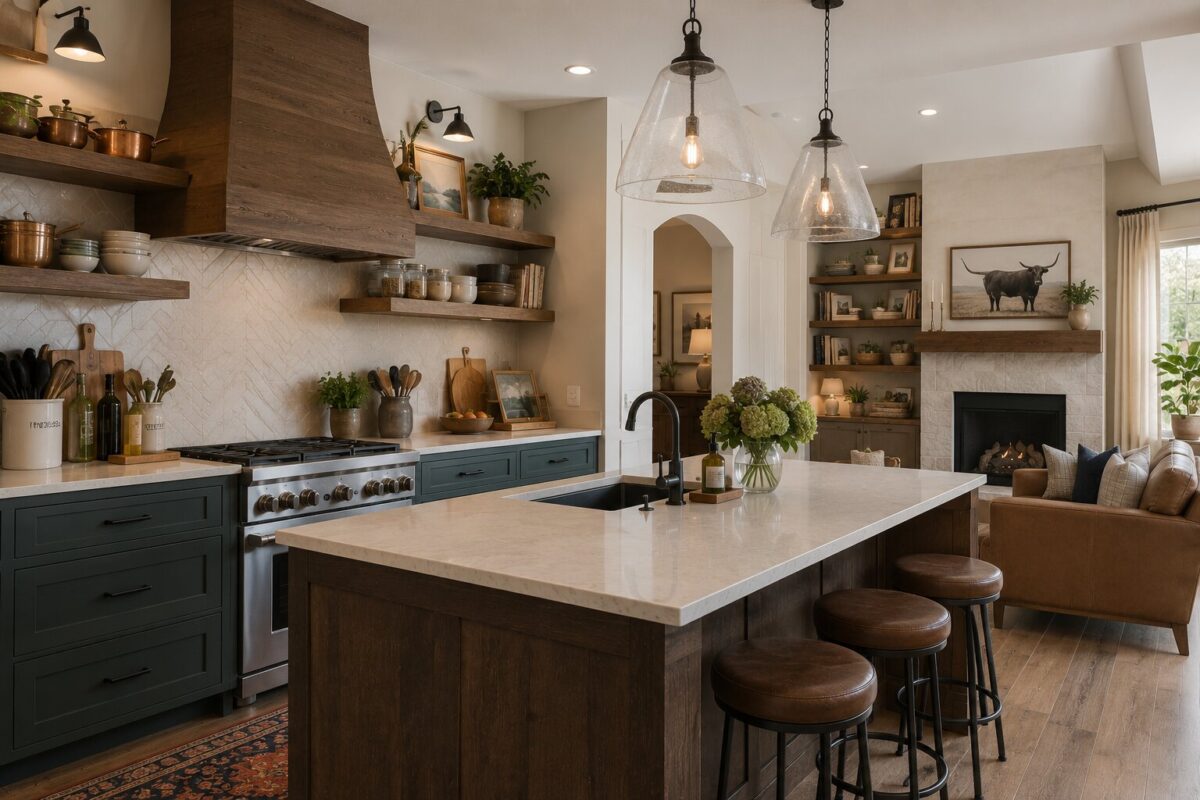
That matters more in some households (and for some objects) than others. Fragile glassware, heirloom dishes, valuable collections, heavy serving pieces or objects with sentimental value deserve more consideration than a stack of bath towels!!
For safety considerations, think about:
- Children
- Pets
- Enthusiastic guests
- Doors that swing nearby
- Traffic patterns
- The possibility of something being bumped or knocked
- How securely the shelf itself will be supported
See more about specific cabinet design for safety and convenience…
Q: What could lighting do for the shelving design?
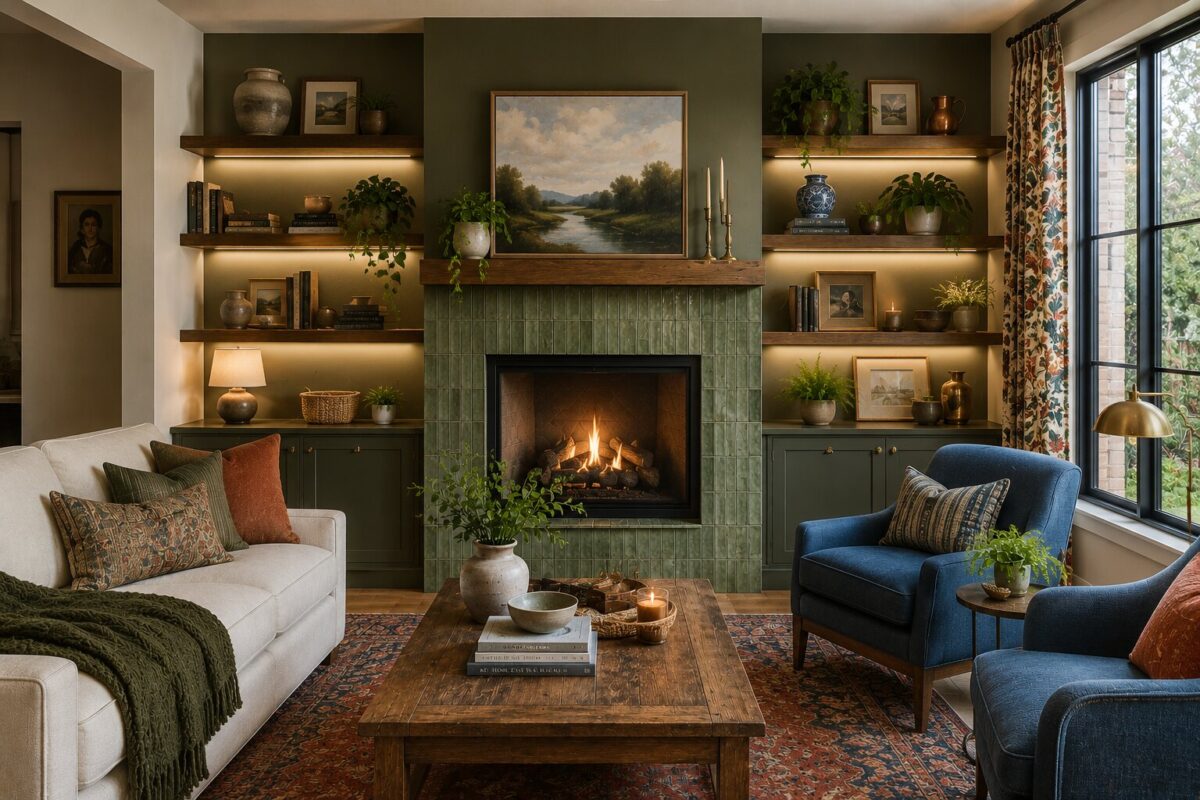
Open shelving can become part of the lighting design, too, in a way that closed shelving can’t. Integrated lighting can illuminate objects on a shelf. BUT lighting needs to be considered along with the shelving rather than added as an afterthought. Wiring, transformers, fixture locations, shelf thickness, glare, shadows and the visibility of the light source can all affect the finished result…
Be sure to think about your shelving at different times of day, too. How does the natural light in the room change from morning to noon to night as the sun makes its way across the sky, from one side of your home to the other?
Q: Will the shelving still work as your life changes?
Good remodeling decisions shouldn’t only work on move-in day, either! What you store today won’t always be what you store five or ten years from now. Children grow, hobbies change, and collections expand (or disappear). You might entertain differently, and what was once display space might eventually become storage.
Closed cabinetry is inherently adaptable because much of what changes is behind closed doors. Open shelving, on the other hand, puts those changes on display.
That doesn’t make open shelving inflexible, but it does make future usefulness worth thinking about before creating something so specialized…
Q: Does the open shelving solve a problem or just follow a trend?
This question is the most important of all. It’s the simplest question, too!! And there are plenty of excellent answers.
Finish your reflections up with the “because” test:
Complete this sentence without referring to a photograph, trend, designer, neighbor, or social-media post: ‘We want open shelving here because __________________________.’
Then, ask yourself:
“Would a cabinet, drawer, niche, ledge, piece of furniture, or nothing at all accomplish that purpose better?”
If open shelving still wins, then you’ve arrived at the decision for a reason. A personal and important one!
Remember our equation?…
Right location + right things + right frequency of use = useful open shelving
When these pieces line up, open shelving becomes MUCH more than a design trend. It becomes a thoughtful detail that makes your home work AND feel distinctly like yours.
And that’s what I call true Return on Enjoyment®!
About the author:

Robin Burrill, RID, NCIDQ, ASID, IDS, CAPS, is an award-winning professional kitchen, bath, and interior designer. Robin and her husband, Robert Mathews, have owned Signature Home Services, Inc. for over three decades, establishing a superior in-house team with a widespread reputation for delivering meticulous design to their many repeat clients.
In 2022, the national publication, Kitchen and Bath Design News magazine, named Robin to their Top Innovator list in recognition of her achievements in the field of kitchen and bath design. In 2024, she was named one of the Fall 2024 Market Pros and “tastemakers” by ANDMORE at High Point Market. In 2024 and again in 2025, Fixr identified her as one of the Top Professional Interior Designers for their nationwide audience. At the start of 2025, she then acted as one of Dallas Market’s “Style Eyes” at Lightovation and Total Home & Gift Market.
Over her extensive career, Robin has been quoted in Architectural Digest and Forbes multiple times; her design work has been featured in top national trade publications; and she has been interviewed for Designers Today magazine’s “Profiles in Design” video series, among others. Widely respected for the depth of her knowledge, Robin is a sought after speaker and judge for many design industry events.
In 2023, Robin designed a bench for Charleston Forge, making her foray into product design. Robin currently serves as a volunteer on the board of the Dallas/Ft. Worth chapter of the Interior Design Society.
Leave a Reply