
Some homes become even more beautiful after sunset. When you walk through the front door, your mood softens. You step into what almost feels like another world…it’s instantly comfortable, and comforting.
Then, there are homes that do the opposite. Night falls, and the home feels sad, even a little depressing. The life left with the last rays of sun! The kitchen lights might be white and overly bright, or the large living room suddenly feels cavernous and empty.
But WHY would one outcome happen, versus the other?
…This is no accident.
In fact, most people only evaluate their homes during daylight hours. They think about daytime brightness, daytime views, daytime photos, daytime curb appeal. And they don’t realize it’s a “daytime-exclusive” evaluation.
Real life also happens after dark, however! This is when families unwind, connect, entertain, watch movies, cook dinner.
Now it’s time to get real: where does your home fall?! Let’s find out…
The evening shifts I love explaining
Most folks don’t think about the following changes that take place in the home environment after sunset. And even if they think about it, they don’t talk about it with the others who live in their home, or bring it up with their interior designer.
But it’s so fundamental!!
This is what happens once the sun disappears and the only light sources are artificial. Your environment is now shaped by:
- Shadows
- Glare
- Bulb color temperature
- Reflective surfaces
- Ceiling height perception
- Contrast
- Dark corners
- Window reflections
The most common culprit of homes that feel anything but relaxing at night is a poor lighting plan. (Not just a shortage of lighting, but a lack of a plan.) I cannot tell you how many beautiful homes I walk into that are flooded with recessed white can lights (and nothing else). Every light is on, and every surface is illuminated. There’s nowhere for the eye to rest!!

These homes feel more like a commercial environment than a personal sanctuary.
At night, we have to decompress, and that means our nervous systems need space to settle down. While they do so, they become FAR more sensitive to comfort, softness, warmth, and visual stimulus.
That’s why, for example, open floor plans suddenly feel cavernous after sunset, even if they felt airy and bright during the day. Large expanses without layered lighting lose intimacy, and tall ceilings can begin to feel disconnected instead of grand.
Homes That Feel Amazing at Night All Have These Things:
This is the TOP differentiator between homes that feel flat at night versus homes that feel amazing.
Properly designed nighttime environments include the three key types of lighting, all planned intentionally to work together. Those are:
- Ambient lighting (i.e., general illumination)
- Task lighting (focused functional lighting)
- Accent lighting (for mood and visual interest)
Lighting zones matter enormously, too.
Also, your home should have the ability to shift moods throughout the evening, or for different occasions. For example, you need specific lighting set-ups for:
- Cooking (i.e., bright)
- Entertaining (soft)
- Winding down (warm)
- Reading (focused)
- Ambiance (glowing, ornamental)
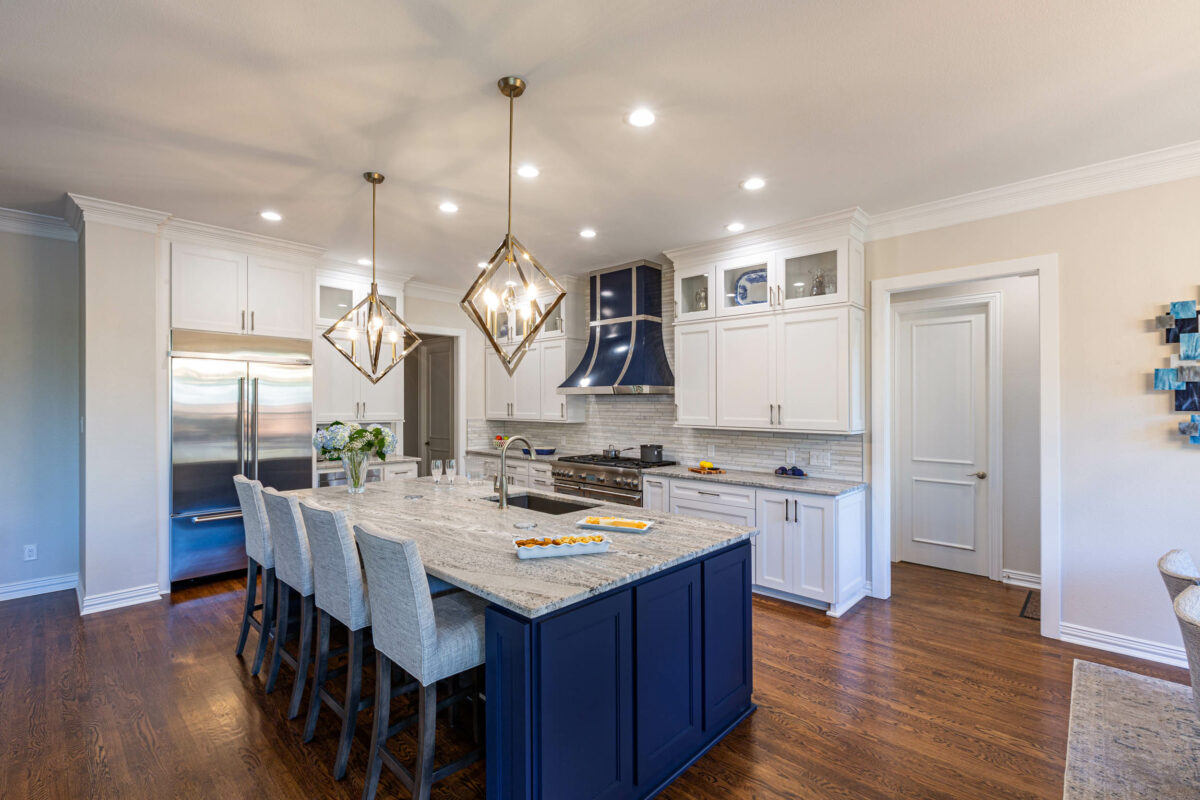
2. Tactile Warmth in Color and Material Selections
There’s also a question of color temperatures and touch in each space.
For example, warm wood becomes even richer after sunset. And honed surfaces absorb light beautifully instead of aggressively reflecting it. And matte paints? They create a look of softness thanks to how light interacts with them.
And on the flipside? What colors and materials look worse at night?
For starters, excessive glossy white surfaces feel cold and clinical, and blue-toned lighting can make spaces feel devoid of emotion. Overly gray palettes (which I’m SO happy finally fell from fashion) specifically lose warmth once sunlight disappears.
Some of the most stunning contemporary homes achieve incredible nighttime warmth through thoughtful material balance and lighting temperature. And homes that don’t take these things into account ultimately lose warmth after nightfall.
3. Intentional Sightlines
Sightlines change at night, too. During the day, natural light fills visual gaps. But after dark, focal points have a bigger impact (for better or worse).
Where does your eye naturally go when you enter each room? What are your intentional AND unintentional focal points?
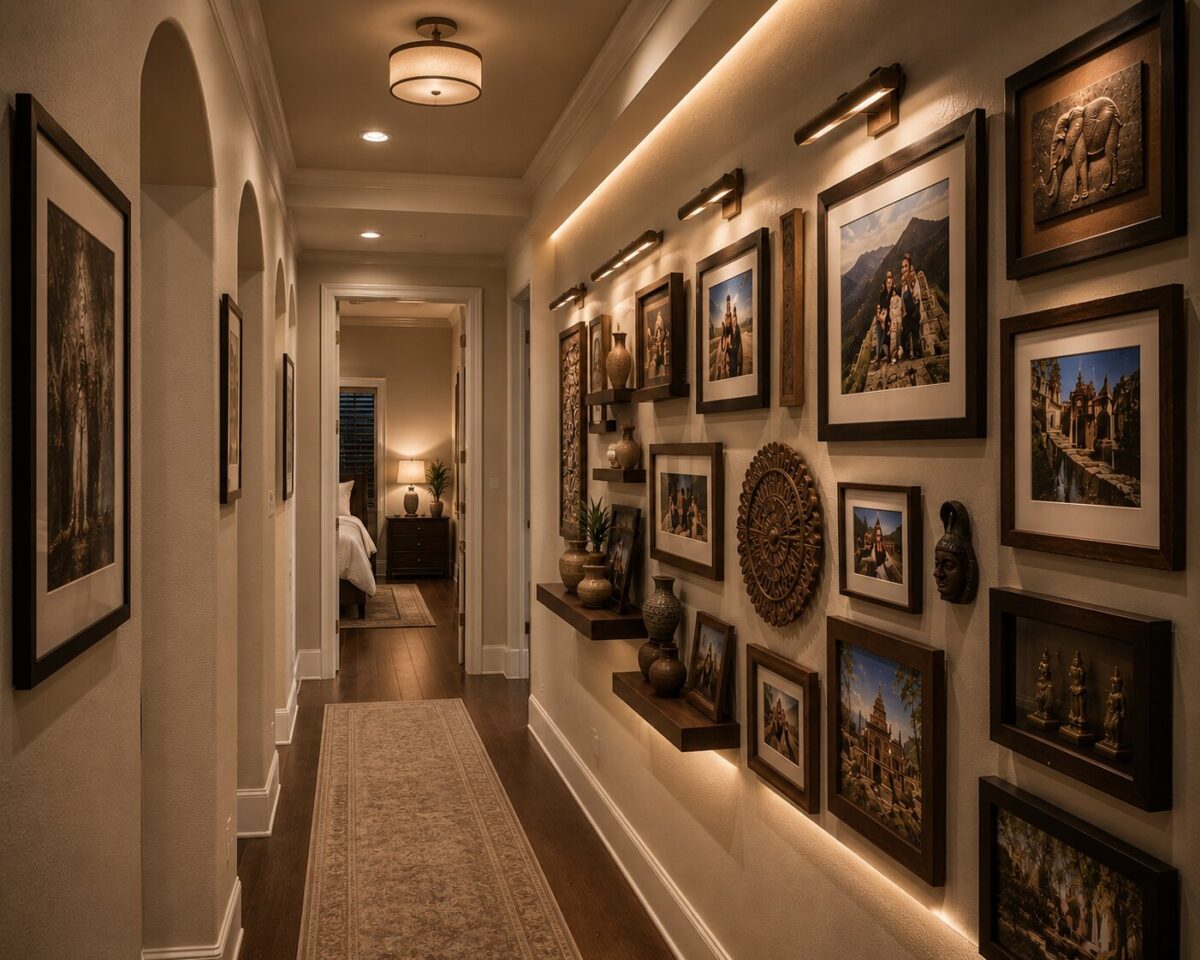
- A softly illuminated hallway?
- A fireplace glow?
- Kitchen pendants shimmering from the next room?
- A beautifully lit tree outside the windows?
- Shelves with gentle accent lighting?
Nighttime focal points (like an illuminated hallway with a gallery wall, or kitchen pendants twinkling from the next room, or a fireplace glow…) bring in stimulating beauty and warmth. They also help the eye move naturally through the home instead of bouncing around.
Bonus thought: How outdoor lighting impacts indoor ambience, too
This is what homeowners almost always underestimate, IF they even think about it at all. (And that’s a big “if.”)
At night, the outdoors becomes part of the interior experience.
Without at least a little exterior lighting, windows turn into black mirrors, and your home suddenly feels visually “cut off” from the world.
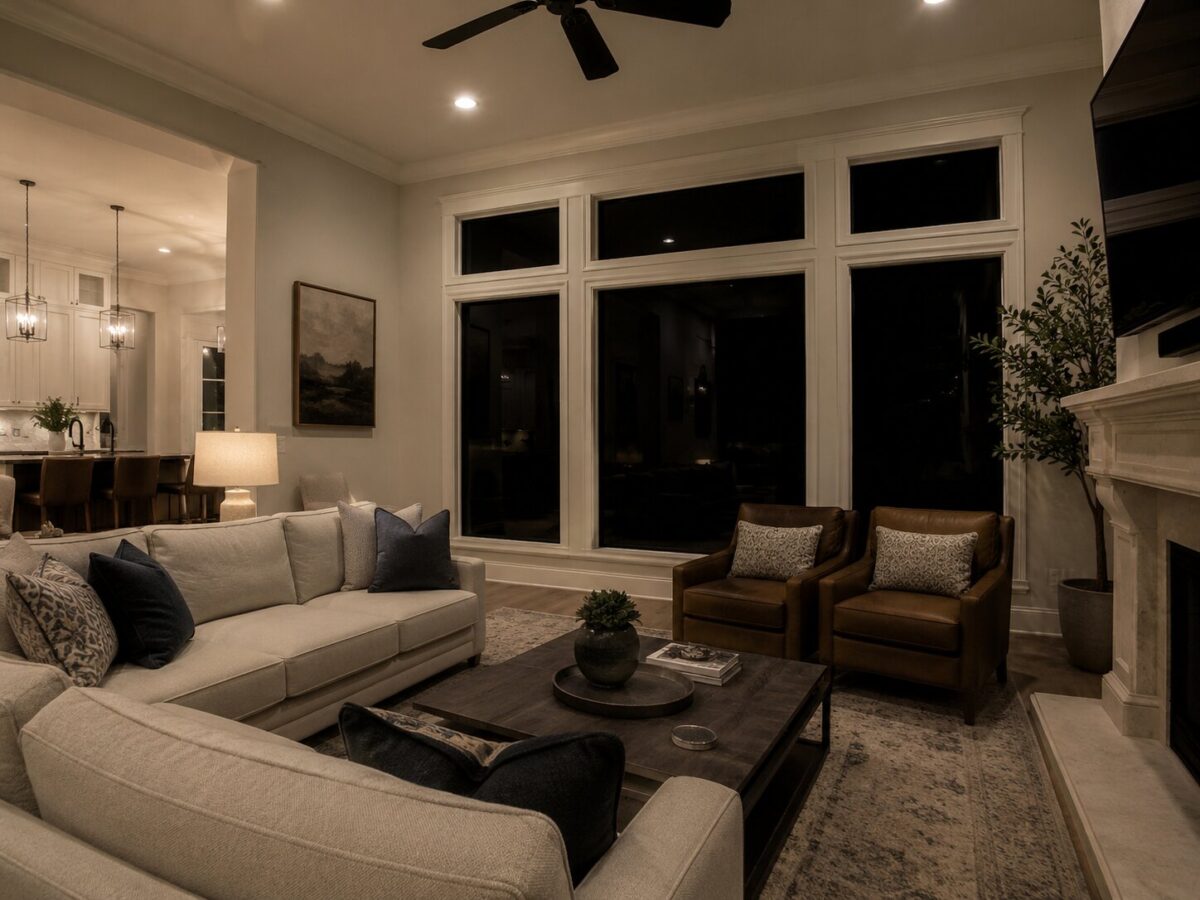
…And when landscape lighting is introduced properly? Everything changes! Then, the eye extends beyond the walls of the home, which is a beautiful sight if the outdoors includes:
- Sculptural trees in the sightline
- Pathways glowing softly
- Architectural details illuminated
- Shimmering pools and hot tubs
- Covered patios
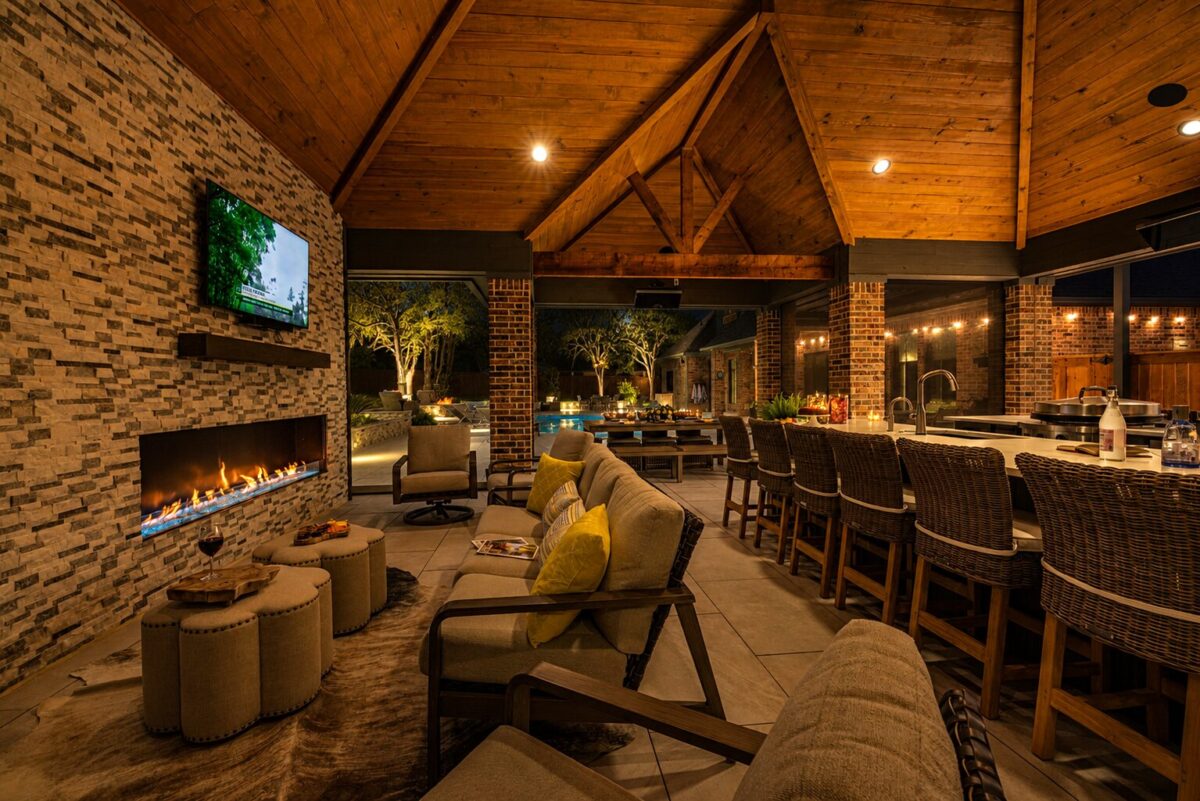
This is especially powerful in indoor-outdoor homes: just look at this expansive indoor-outdoor project of ours, which won us NARI’s Contractor of the Year on a national level!
Small Changes That Quickly Add That “Cozy” Feeling at Night
The good news? You do NOT necessarily need a full renovation to improve how your home feels after dark. Some relatively small changes can create dramatic results…
For example:
- Replace your cool bulbs with warmer temperatures right away
- Add dimmers throughout the home—seriously, everywhere!!
- Get quality bulbs, too…for just a few dollars more, you’ll avoid flickering when they’re dimmed
- Introduce lamp lighting instead of relying solely on overhead cans
- Add interior cabinet lighting or toe kicks
- Illuminate your artwork and focal points!
- Add subtle exterior pathway lighting
- Soften any highly reflective surfaces with décor
One of the best mental exercises you can do right away is to simply walk through your home at night with fewer lights on. Ask yourself, where does your home feel inviting? Where does it feel harsh? Where do people naturally gather? Which spaces do y’all avoid?!
Some homes are designed almost entirely around daylight performance. Perhaps most of them. And honestly, daylight is forgiving!! Large windows look better and open layouts feel airy. All your paint and textile colors look just the way you imagined when you selected them.

But then, night falls. What was airy now feels sterile. Colors change. Glare is everywhere. Rooms lose depth. And you feel isolated in a house of black mirrors looking out over the dark yard.
This is why I always encourage homeowners to evaluate their homes BOTH during the day and at night. This simple exercise helps ensure you design a home that feels extraordinary all day long, and that you therefore get REAL Return On Enjoyment®.
If you’d like some help evaluating how your home functions emotionally and visually throughout the entire day, schedule a 15-minute video conference with me!!
About the author:

Robin Burrill, RID, NCIDQ, ASID, IDS, CAPS, is an award-winning professional kitchen, bath, and interior designer. Robin and her husband, Robert Mathews, have owned Signature Home Services, Inc. for over three decades, establishing a superior in-house team with a widespread reputation for delivering meticulous design to their many repeat clients.
In 2022, the national publication, Kitchen and Bath Design News magazine, named Robin to their Top Innovator list in recognition of her achievements in the field of kitchen and bath design. In 2024, she was named one of the Fall 2024 Market Pros and “tastemakers” by ANDMORE at High Point Market. In 2024 and again in 2025, Fixr identified her as one of the Top Professional Interior Designers for their nationwide audience. At the start of 2025, she then acted as one of Dallas Market’s “Style Eyes” at Lightovation and Total Home & Gift Market.
Over her extensive career, Robin has been quoted in Architectural Digest and Forbes multiple times; her design work has been featured in top national trade publications; and she has been interviewed for Designers Today magazine’s “Profiles in Design” video series, among others. Widely respected for the depth of her knowledge, Robin is a sought after speaker and judge for many design industry events.
In 2023, Robin designed a bench for Charleston Forge, making her foray into product design. Robin currently serves as a volunteer on the board of the Dallas/Ft. Worth chapter of the Interior Design Society.
Leave a Reply