
If you’ve ever watched a home renovation show (and y’all know what I think about those), you might have been conditioned to think that removing a wall is simple.
“Find the wall. Swing the hammer. Create an open floor plan!”
But the wall is usually the least interesting (and least challenging) part of these designs. Especially in older homes.
And, by the way…homes in the U.S. are aging. Since 2000, the average age of American homes has gone from 31 to 41 years. That’s a HUGE difference! So, a ton of y’all are probably in homes that were built in the 1980s (or earlier).
There are potential treasure troves when removing an old wall, too. For example, opening a wall can uncover beautiful original construction details.
When it comes to you and your home, before you even start dreaming about one large open space, it’s crucial to understand what could be lurking behind that drywall, plaster, trim, and paint.
Let’s take a look!
Older Walls Often Contain materials That Require Special Handling
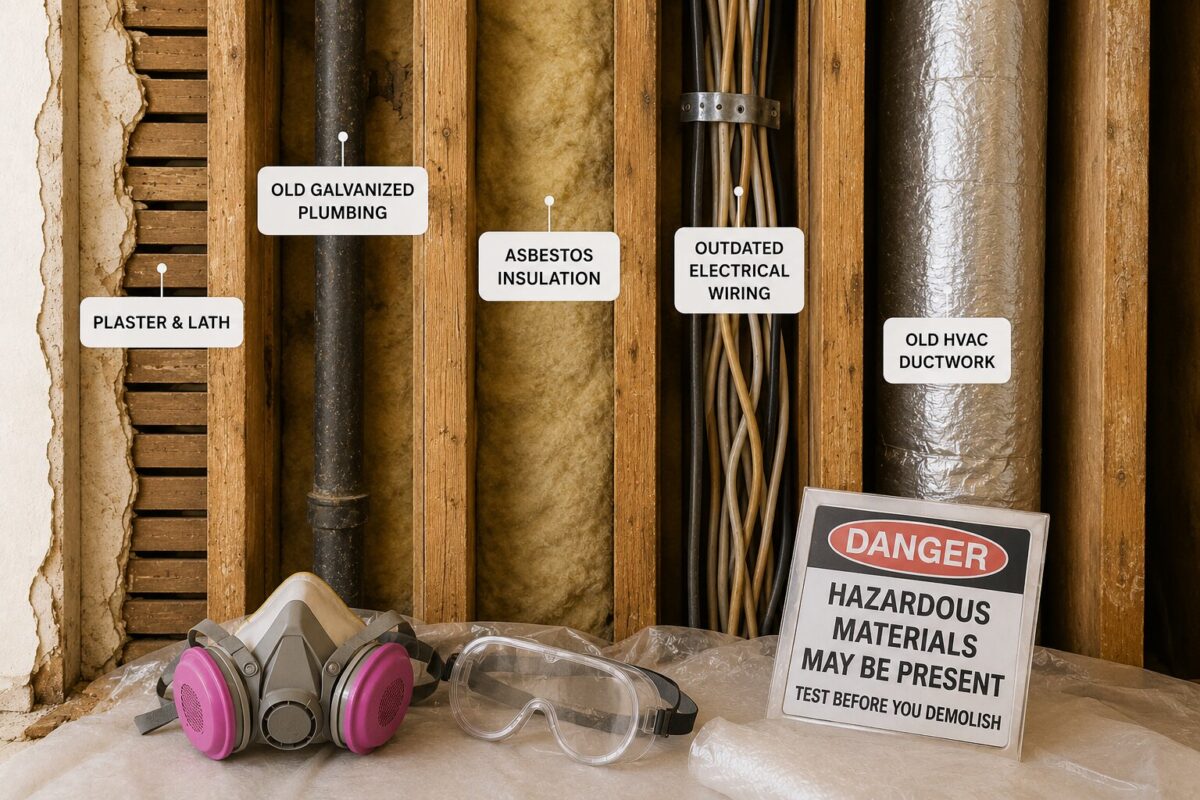
Depending on when your home was built, there will be different materials used in and behind the walls. Some of the materials will require special handling, starting with lead paint and asbestos-containing materials.
In these cases, testing is the first step before demolition.
Here’s a quick look at what other materials are common in homes of a certain age:
Homes built before 1950…
- Yes, homes built before 1950 commonly had lead-based paints
- Asbestos-containing insulation was common around pipes, furnaces and ductwork
- What’s called “plaster-and-lath” was common in many areas, too
- In parts of Texas, homeowners also discover decades of foundation movement repairs due to our expansive soils…
Homes from 1950-1978…
- Once we move to the 1950-1978 timeframe, lead-based paint and asbestos-containing materials were still common
- Galvanized steel plumbing from this era would also now be nearing the end of its useful life
- And electrical systems from this time period were designed for a MUCH lower demand than today’s households require!!
Homes built between 1965 and 1973 also sometimes have aluminum branch-circuit wiring, which requires special modifications today. Aluminum wire, too, requires proper upgrades when older walls are opened.
Homes built in the 1980s and 1990s…
- Electrical systems in these homes also lack sufficient outlets and dedicated circuits for today’s tech-heavy lifestyles
- These plumbing systems are generally approaching replacement age, too
- Original ductwork is undersized for today’s A/C comfort standards
And homes of this age alwayshave evidence from previous remodels…and they were not remodels done by today’s standards, which brings me to:
You might Be Opening a Time Capsule (of Previous Remodels)
One of my favorite things to remind clients is that every home tells a story. And I don’t mean your story. I mean the story of who lived there before, and what updates were made!!
The thing is, sometimes that story includes some random homeowner from 1987 who made some decidedly “interesting” decisions.
For instance, I’ve seen walls conceal:
- Patched framing
- Abandoned wiring
- Questionable plumbing modifications
- Hidden repairs
- And evidence of remodels that were not properly documented
The older the home, the more likely it is that someone has already modified it (once, twice, or many more times). So what you’re removing isn’t always what was originally built!!
Older Electrical Systems Were NOT Designed for Modern Life
Think about how people lived 40 or 50 years ago. (If you’re old enough to remember, just think back!)
There were no home offices, and there certainly weren’t the number of outlets as we have now. There were no charging stations or in-home theaters. There were no gaming systems or tablets or smart appliances all competing for power, either.
And so, removing a wall today will pretty much always expose older electrical systems that no longer support how we live. The good news? This gives you a GREAT opportunity to upgrade wiring, add outlets, improve lighting plans, and future-proof your space.

Plumbing, HVAC, and Gas Lines Can Be Hiding in Unexpected Places
Walls are rarely empty. And I’ve already covered electrical. Next, let’s talk plumbing. Most walls contain some combination of:
- Supply lines
- Drain lines
- Vent stacks
- Ductwork
- Returns
- Gas lines
- And other mechanical systems
In older homes, these systems were installed differently than they would be today. Go figure! For you, this means that updates and relocation might be more complicated than you expect.

This is one of many reasons why I recommend approaching each older home with curiosity instead of assumptions.
Hidden Damage That’s Invisible Until Demolition
Sometimes walls do a VERY good job of hiding problems. Like:
- Water intrusion
- Insect damage
- Different kinds of rot
- Settling
- And previous repairs
Most older homes have accumulated at least one surprise or two over the decades. So, what’s a homeowner to do?! Hope for the best, and plan for the unexpected. And please, work with a full-service design-build contractor who’s prepared for anything!!
Architectural Details Worth Saving
Now let’s talk about the FUN surprises! Because, yes, sometimes opening a wall reveals beautiful original materials, framing details, trim work, or architectural elements that add tremendous character to your home. These are the details people spend BUCKETS on to add later.
(Continue reading to see who should add historical elements, and when.)
I’ve actually seen clients become more excited about what was discovered inside the wall than the original design plans for their remodel!!

Matching Floors and Ceilings…Not Easy, and Often Forgotten!
It’s not just the wall, or what’s in it. How about what’s UNDERNEATH it?!
Once a wall is removed, you could also discover:
- Missing flooring (very common)
- Mismatched materials (even more common)
- Uneven floor heights
- Ceiling inconsistencies
- And more evidence of previous renovations!!
It’s a requisite to create a seamless, finished appearance in your renovation, of course, so that will include more work than removing the wall itself. This is all the more reason to ask a professional to see what’s possible!!
…Yes, You Still Need to Know Whether the Wall Is Load-Bearing
I know some of y’all were waiting for this one!!
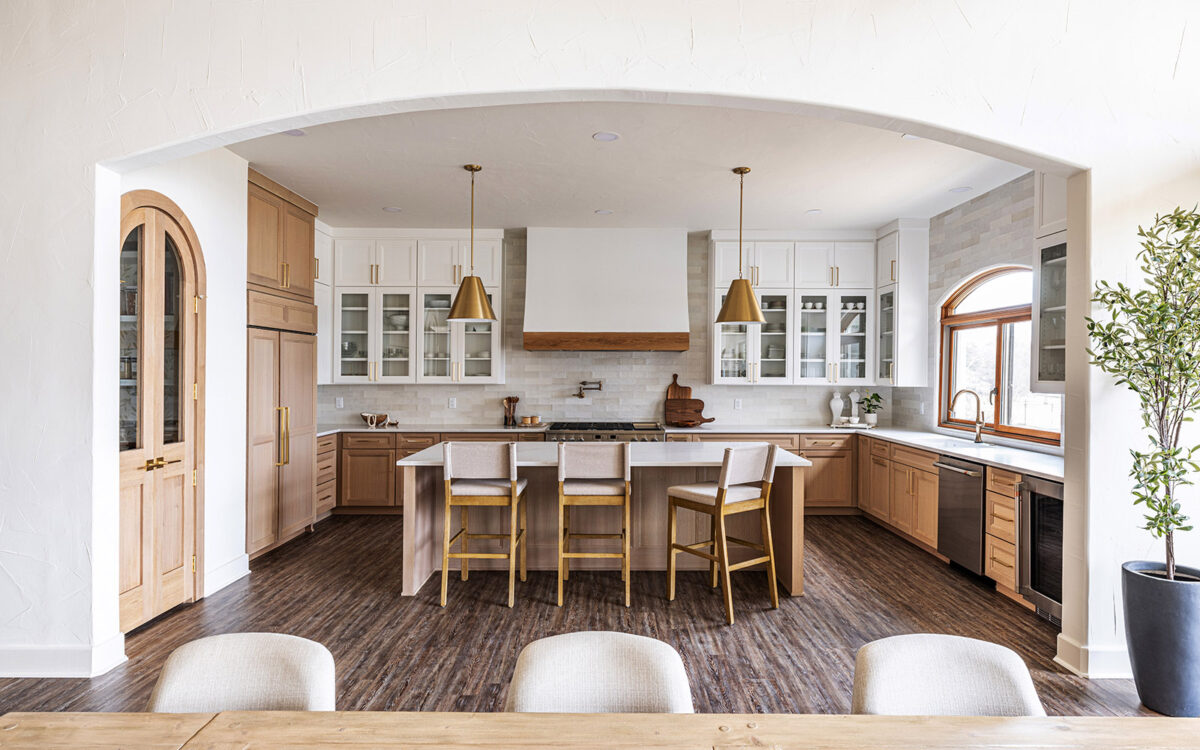
Yes, load-bearing walls matter. If the wall you want to remove supports structural loads from the roof, attic, or upper floors, those loads must be transferred elsewhere through properly engineered beams and supports.
For instance, see what we did to the load-bearing wall in this open kitchen and living design!!
The key point here is that load-bearing status is important, but it is NOT the only thing that’s important.
And for that matter…
One of the biggest mistakes I’ve ever seen is when a homeowner chases an open floor plan simply because it’s popular.
Read the truth about open floor plans here.
Sometimes, the wall in question provides privacy, noise control, furniture placement opportunities, or visual separation that serves your home well. At least, the way you want to live in it.

READ: Good design is about function first!!
Moral of the story: Budget for More Than Demolition!!
The wall demo itself is one of the least expensive parts of a project. What folks forget to account for includes:
- Permits
- Engineering
- Electrical work
- Plumbing modifications
- HVAC relocation
- Flooring repairs
- Ceiling repairs
- Finish carpentry
- Painting
The true cost of a wall removal is in everything that happens after the wall comes down.
What could your home look like with a specific wall removed?! Why not schedule a 15-minute video call with me to find out!!
About the author:

Robin Burrill, RID, NCIDQ, ASID, IDS, CAPS, is an award-winning professional kitchen, bath, and interior designer. Robin and her husband, Robert Mathews, have owned Signature Home Services, Inc. for over three decades, establishing a superior in-house team with a widespread reputation for delivering meticulous design to their many repeat clients.
In 2022, the national publication, Kitchen and Bath Design News magazine, named Robin to their Top Innovator list in recognition of her achievements in the field of kitchen and bath design. In 2024, she was named one of the Fall 2024 Market Pros and “tastemakers” by ANDMORE at High Point Market. In 2024 and again in 2025, Fixr identified her as one of the Top Professional Interior Designers for their nationwide audience. At the start of 2025, she then acted as one of Dallas Market’s “Style Eyes” at Lightovation and Total Home & Gift Market.
Over her extensive career, Robin has been quoted in Architectural Digest and Forbes multiple times; her design work has been featured in top national trade publications; and she has been interviewed for Designers Today magazine’s “Profiles in Design” video series, among others. Widely respected for the depth of her knowledge, Robin is a sought after speaker and judge for many design industry events.
In 2023, Robin designed a bench for Charleston Forge, making her foray into product design. Robin currently serves as a volunteer on the board of the Dallas/Ft. Worth chapter of the Interior Design Society.
Leave a Reply