
According to my 30+ years of sitting down with folks for remodel consultations, plus all the “top searches” in Google over time, I can tell you that people almost always start with their remodel budgets as the first step of their projects. Then they think about what they can getwith that investment.
Unfortunately, searching “average kitchen remodel cost” or similar won’t ever get you a simple answer. Because that’s not actually what comes first.(My kitchen remodel cost infographic shows you why.)
Proof that starting with a budget will only confuse things: Think about how two homeowners can invest the same amount in a kitchen project…and come away with COMPLETELY different results.
Since y’all really do want to know what things cost, and since the answer “it depends” doesn’t satisfy that curiosity, I want to show you EXACTLY what I mean.
So…
Keep reading to see TWO side-by-side comparisons of kitchen renovations we’ve done that each were roughly the same investment…but which obtained COMPLETELY different results. That way, you can see where budgets are allotted, and start to see your investment come into focus, based on what you want and need.
Side-by-Side #1: The Kitchen+ Reconfiguration vs. The Statement Kitchen
These first two kitchen remodel projects were completed at a similar investment level, both in the upper range of a full-scale kitchen remodel. Think of them as the kind of projects whose budgets reflect a serious commitment to improving how the home lives and feels.
(Remember, you can download my infographic to see the range of investment levels for kitchen remodels.)
So…what did each homeowner prioritize? That’s the question to ask, because that’s where everything changes!!
Project 1: The Kitchen+ Reconfiguration
This family looked at their home and thought: “The kitchen needs to be functional, but we want the adjacent spaces to make sense with the updated kitchen, too.”
Here’s where the money went:
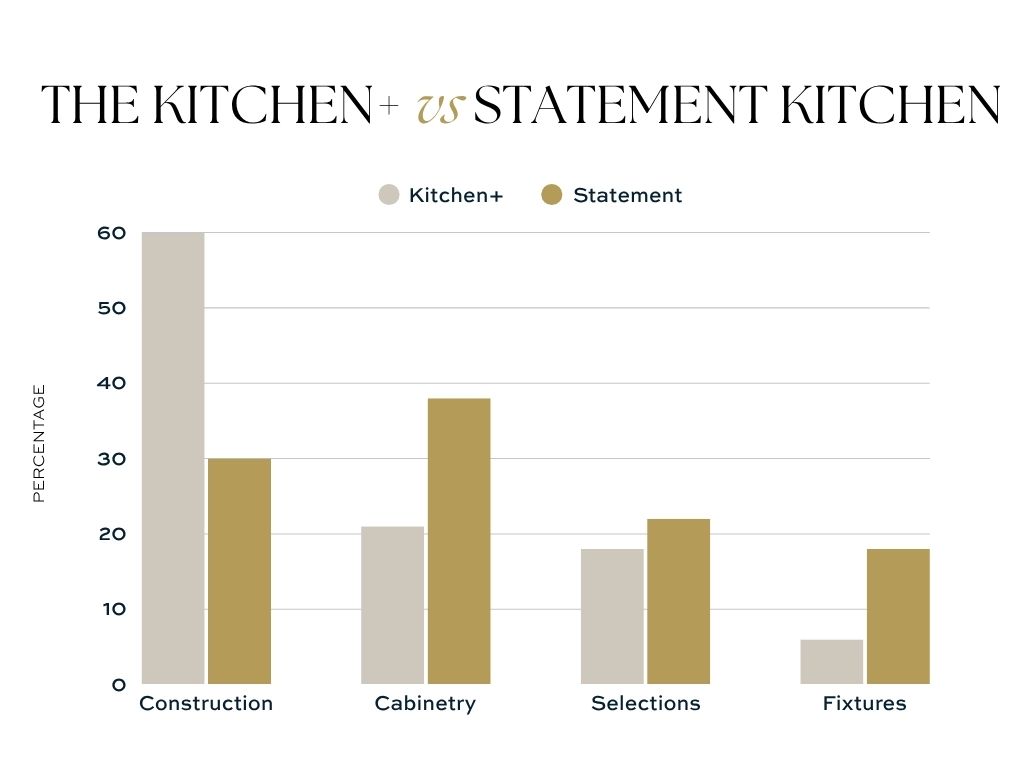
- ~60% construction and systems (demolition, framing, plumbing, electrical, drywall, project management)
- ~20% cabinetry and custom built-ins
- ~15% hard selections (tile, countertops, flooring)
- ~5% fixtures and lighting
What does that mean in real life?
Most of the investment went into what you don’t see, including: the structure of the home, how spaces connect, and how plumbing and electrical support the layout.
The result?
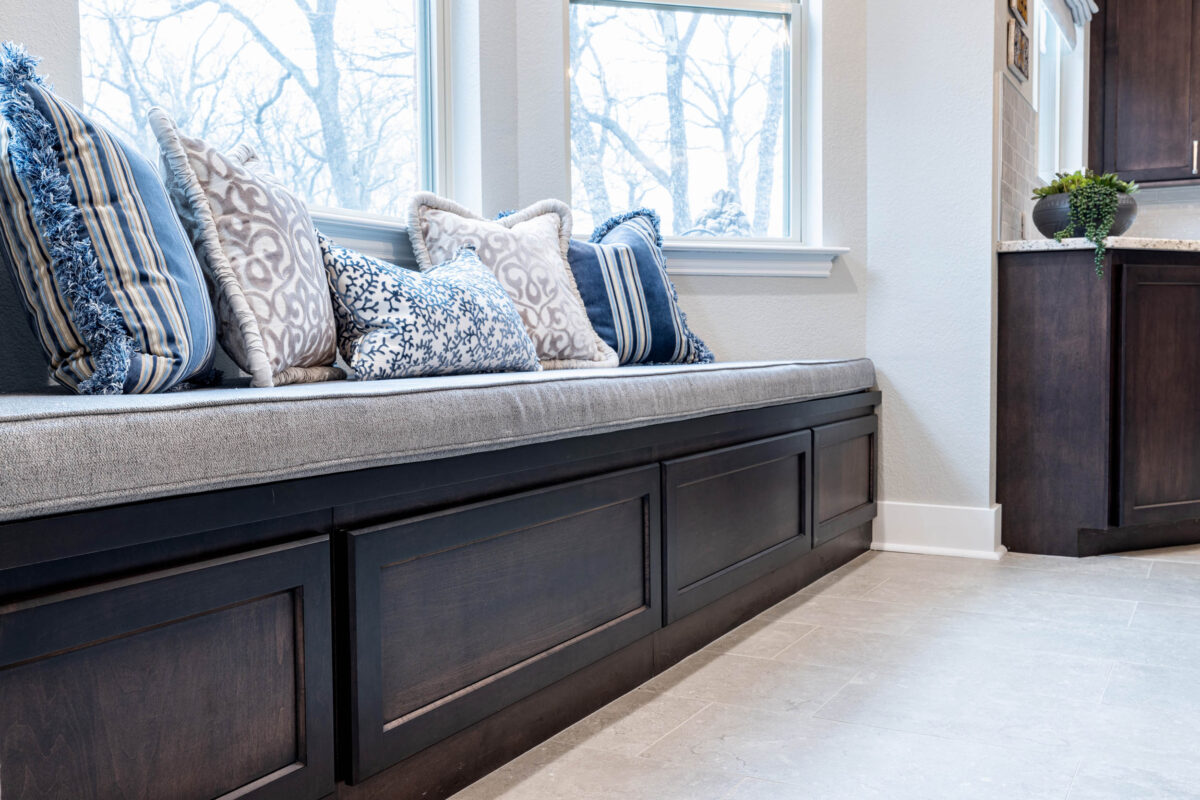
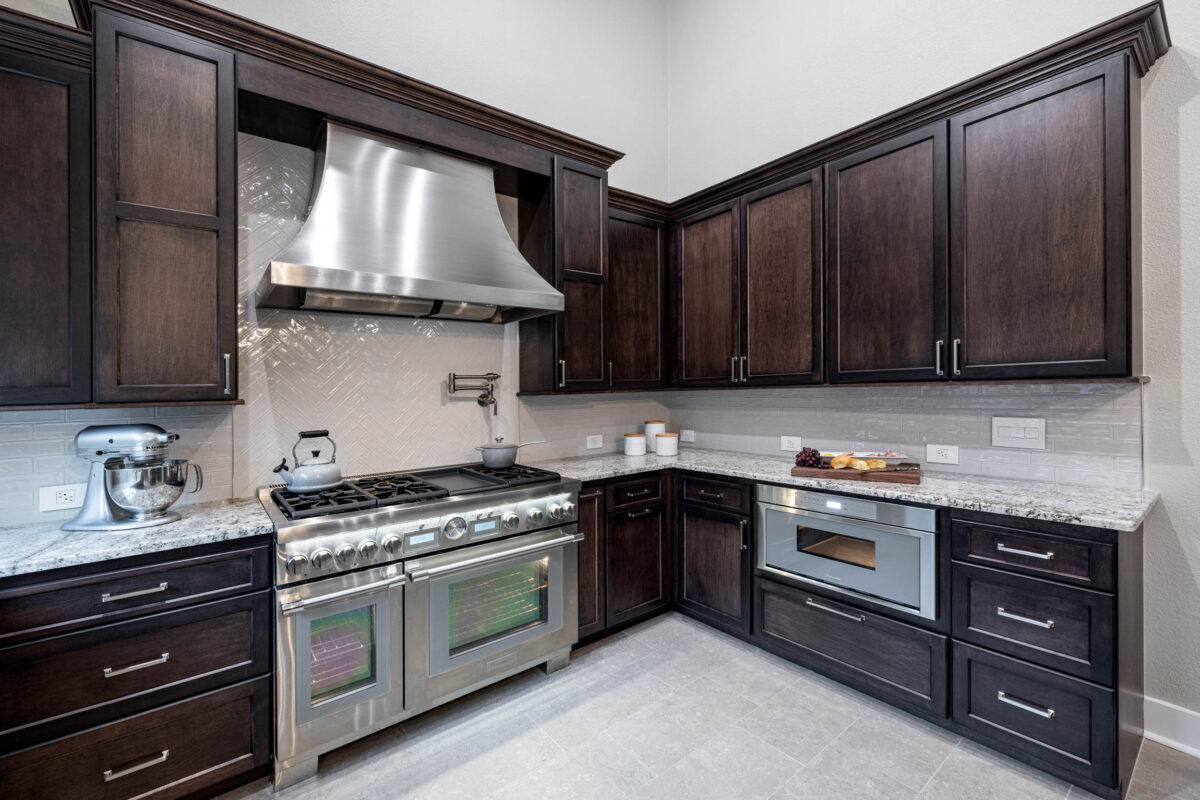
A home that feels more intuitive and more livable every day. Not all the are immediately visible for friends and family who swing by, but the craftsmanship and usability of each space are felt constantly. The way the rooms connect, the way storage makes sense, the way the layout nurtures interactions…this was definitely a structurally-driven remodel.
Project 2: The Statement Kitchen
Compared with the kitchen above, this family made a different decision as to where their kitchen remodel budget would go. Instead of spreading the investment across the adjacent living spaces, they concentrated it in the kitchen, and not just ANY kitchen. It became a space designed to gather, to elevate their daily life, and to impress guests…but not with trendy or blingy selections, rather a luxuriously comfortable and interaction-nurturing environment.
Here’s how the budget shifted:
- ~30% construction and systems
- ~35% custom cabinetry
- ~20% hard selections (countertops, backsplash, flooring)
- ~15% fixtures, lighting and other details
Notice the difference?
Cabinetry becomes the largest category for this kitchen project…and that’s not an accident!! The driving influence of cabinetry, after all, is to create a “new normal” for storage and daily usability, as well as to determine visual impact.
Less money went into restructuring the space, and more went into what you see, touch, and interact with every day.
The result?
A kitchen that feels like an entirely new home!! This is what I call an experience-driven remodel.
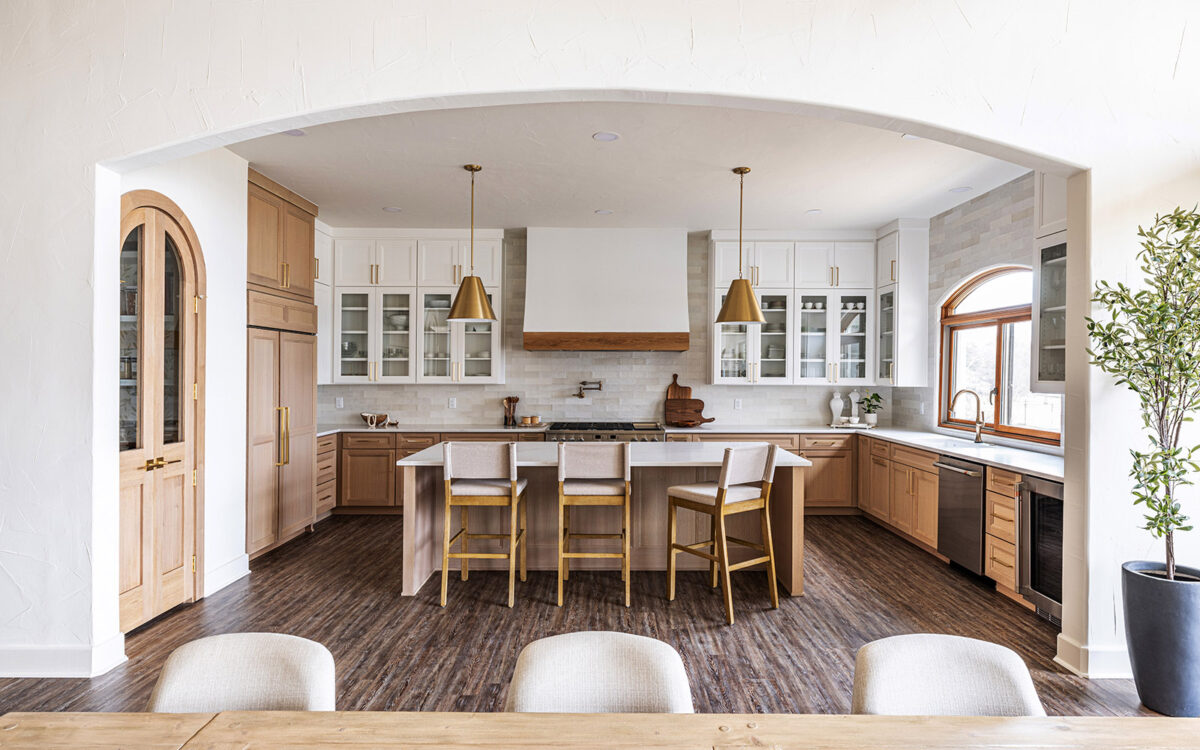
Get the full before-and-after kitchen remodel story on this project in our portfolio!!
What’s the takeaway when comparing these two kitchens?
Same general investment range, each project within a few thousand dollars of the other. But…
- One project put 60% into infrastructure
- The other put 55% into visible elements (cabinetry, selections and fixtures)
That shift is why one home feels better to live in…and the other feels like a new and beautiful experience.

The MOST important takeaway is that neither one is “right.” It comes down to what matters most to you.
Side-by-Side #2: The Balanced Upgrade vs. The Product-Focused Remodel
Next, let’s look at two more kitchen renovation projects…this time at a slightly lower investment level. (These budgets were about 10% below the first set above, sitting more in the middle of a high-end kitchen remodel budget range.)
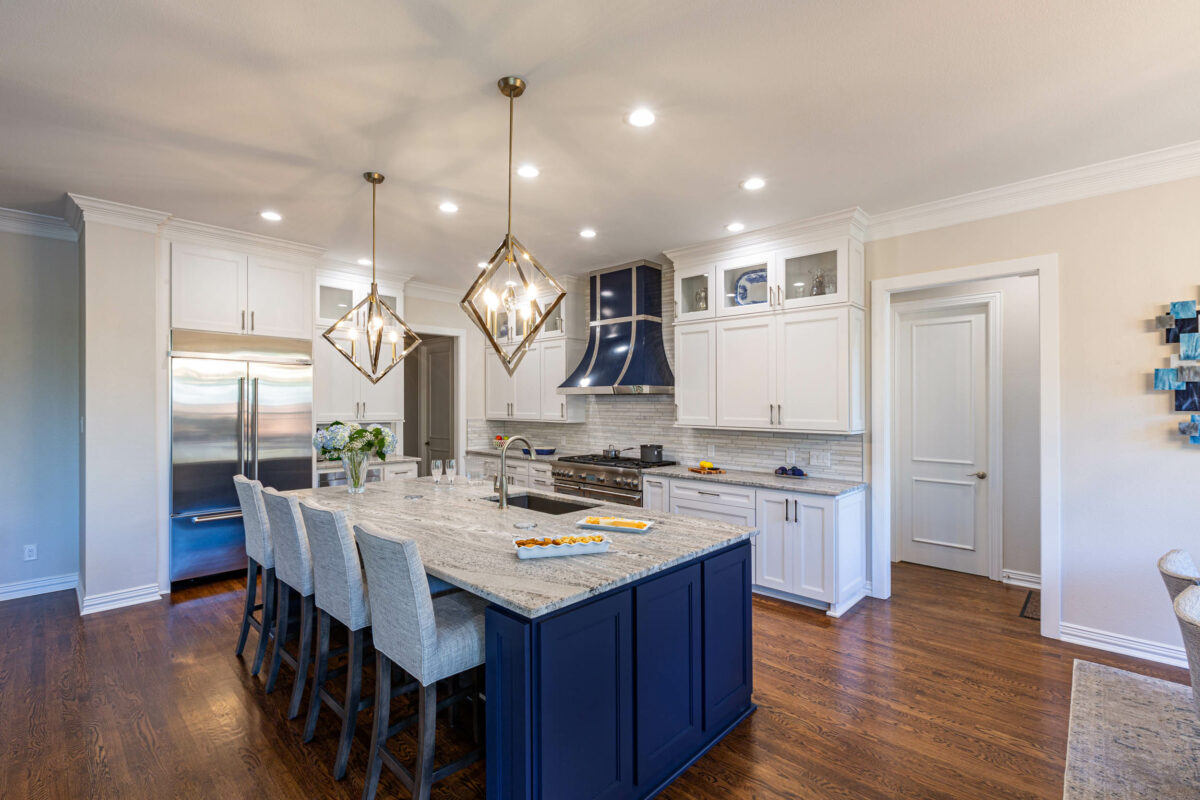
Project 3: The Balanced Upgrade
Here’s how the owner of this home approached this kitchen remodel:
“We want everything to feel updated, but without going all-in on any one space.”
And that’s what shaped the allocation of their remodel budget:
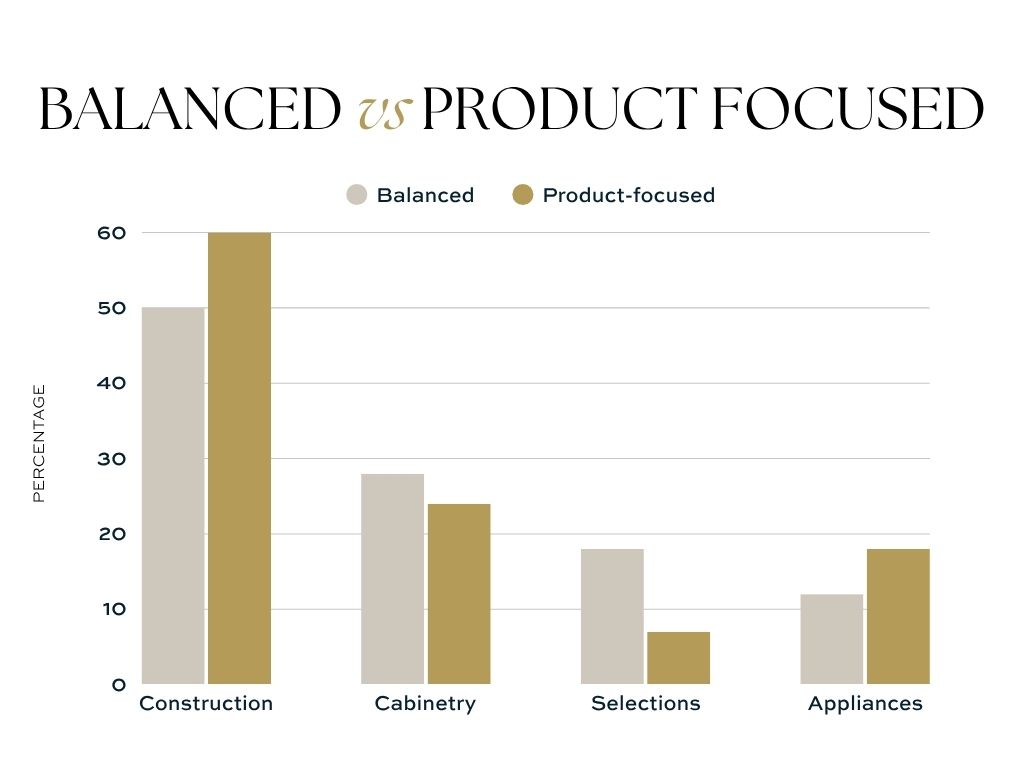
- ~50% construction and systems
- ~25% cabinetry
- ~15% hard selections
- ~10% fixtures and appliances
This is what you could call a textbook example of a balanced remodel. You still invest heavily in the foundation of the home, but leave enough of your investment to also upgrade cabinetry, refresh finishes, AND improve the overall visual experience.
The result?
The kitchen and its adjacent areas all feel upgraded, and therefore cohesive. No detail or space stands out as “outdated,” because nothing was overlooked.
Project 4: The Product-Focused Remodel
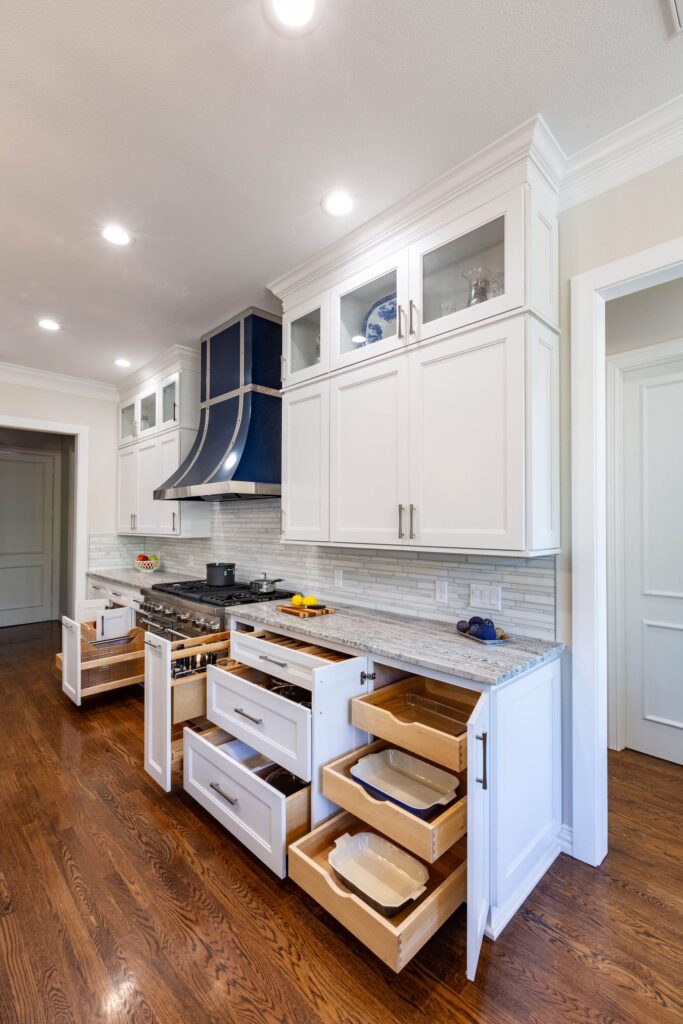
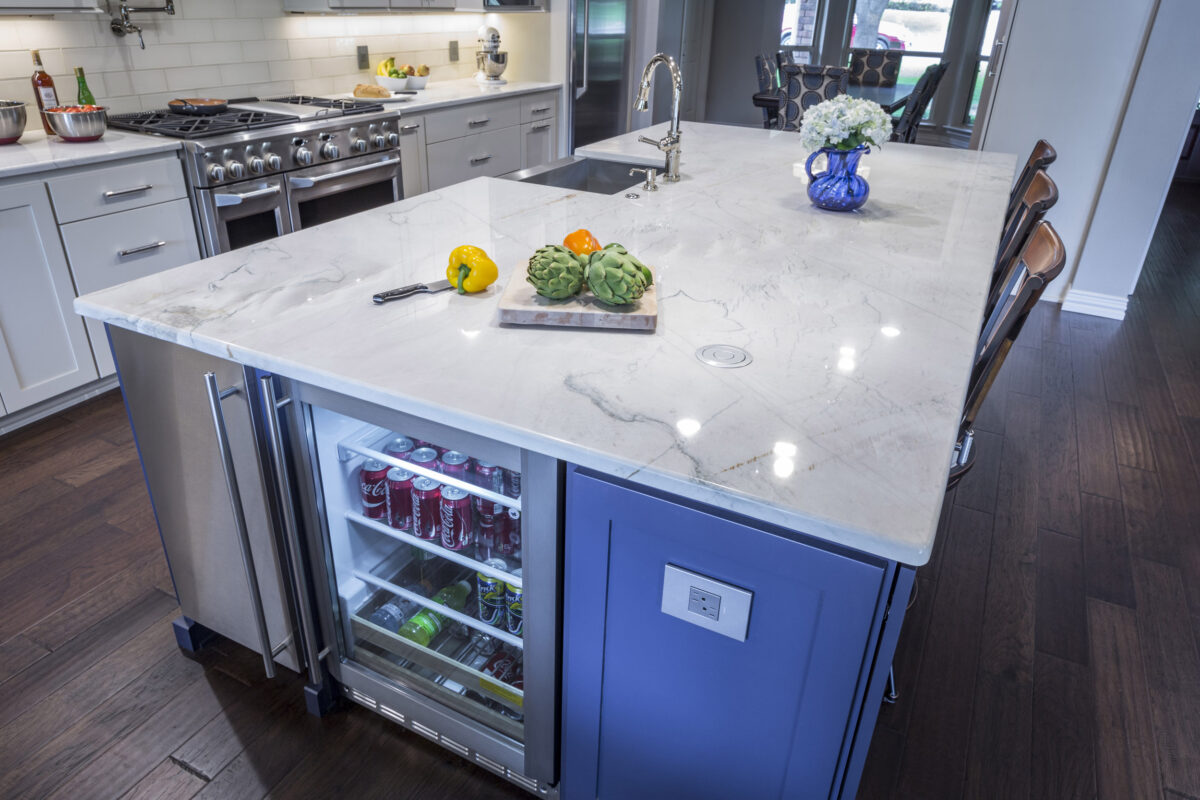
This homeowner took a more targeted approach, honing in on exactly what the kitchen needed to do, and the products that would make that possible.
Once again, while this kitchen remodel represents the same general investment as the previous project, it had a very different allocation.
Here’s where the money went:
- ~55% construction systems
- ~22% cabinetry
- ~18% appliances and products
- ~5% hard selections
What do you see? For starters, a larger portion of the budget went into appliances and specific functional upgrades. And less went into layered finishes.
The result?
A home that works better in very specific ways, without the same level of transformation in how the space looks. This is what I’d call a functional refresh.
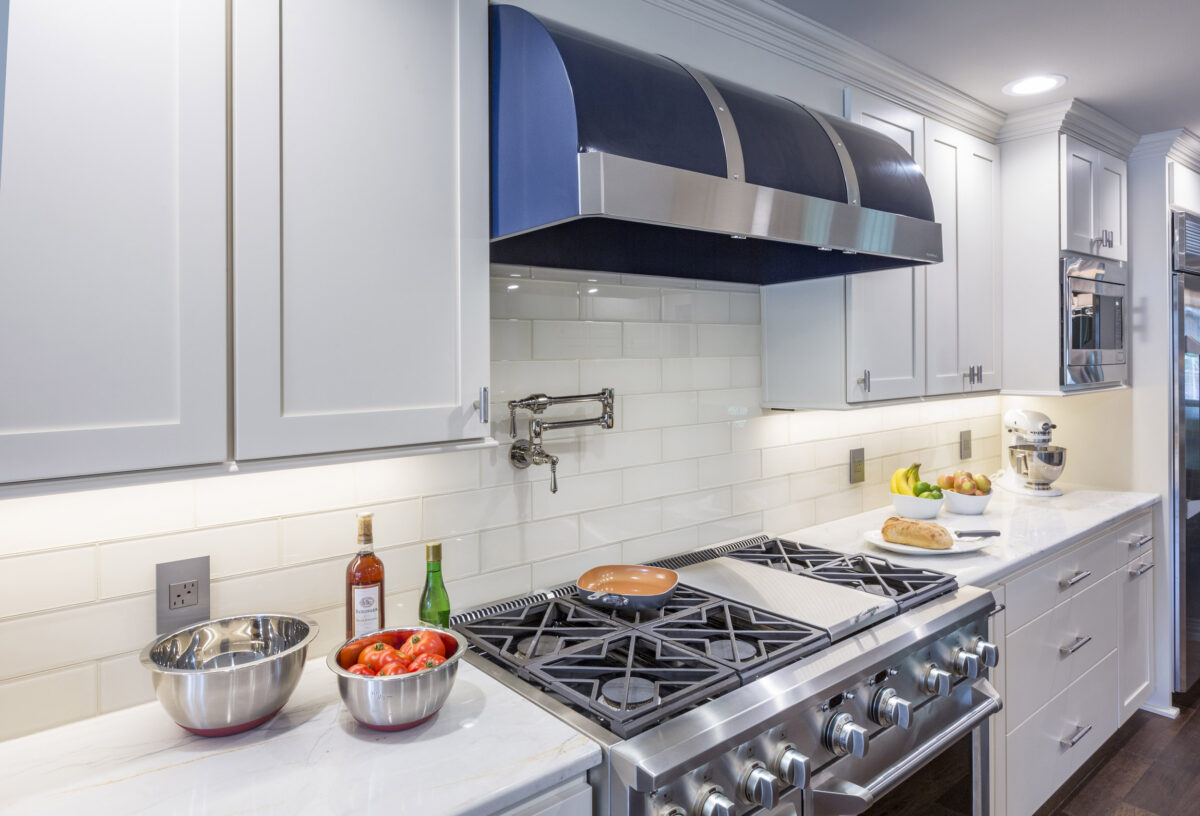
What’s the takeaway from all four kitchen remodels?
Across all four projects, one truth shows up again and again:
Construction and systems take up about half the budget.
That’s your baseline! From there, the difference comes down to how the remaining 40–50% is used:
- Invest it in cabinetry → You get visual impact
- Invest it in finishes → You get material longevity and personalization
- Invest it in appliances → You get custom, functional upgrades
- Spread it out → You get balance
What’s this mean for your kitchen remodel?
I hope now you can see why it’s actually faulty logic to assume, “If I spend X, my home will look like Y.” It’s not the number, but how you distribute it. So looking for some “one size fits all” kitchen budget really tells you nothing.
Here are some better questions you can:
- Do I want visual impact or a structural focus?
- Do I want lifestyle transformation or improvement?
- Do I want one incredible space, or a better overall home?
Answer these, and then your investment starts working for you, instead of just being spent.
And THAT’S where the real magic of remodeling happens!!

Drop a comment here with your thoughts, your first reaction…or reach out to schedule a 15-minute video call with me to put your answers to work for you with a plan for your perfect kitchen remodel!!
About the author:

Robin Burrill, RID, NCIDQ, ASID, IDS, CAPS, is an award-winning professional kitchen, bath, and interior designer. Robin and her husband, Robert Mathews, have owned Signature Home Services, Inc. for over three decades, establishing a superior in-house team with a widespread reputation for delivering meticulous design to their many repeat clients.
In 2022, the national publication, Kitchen and Bath Design News magazine, named Robin to their Top Innovator list in recognition of her achievements in the field of kitchen and bath design. In 2024, she was named one of the Fall 2024 Market Pros and “tastemakers” by ANDMORE at High Point Market. In 2024 and again in 2025, Fixr identified her as one of the Top Professional Interior Designers for their nationwide audience. At the start of 2025, she then acted as one of Dallas Market’s “Style Eyes” at Lightovation and Total Home & Gift Market.
Over her extensive career, Robin has been quoted in Architectural Digest and Forbes multiple times; her design work has been featured in top national trade publications; and she has been interviewed for Designers Today magazine’s “Profiles in Design” video series, among others. Widely respected for the depth of her knowledge, Robin is a sought after speaker and judge for many design industry events.
In 2023, Robin designed a bench for Charleston Forge, making her foray into product design. Robin currently serves as a volunteer on the board of the Dallas/Ft. Worth chapter of the Interior Design Society.
Leave a Reply