
Most people don’t realize how much their kitchen asks them to adapt. For example:
- Stepping aside so someone can open the fridge.
- Pausing mid-prep because a drawer blocks your path.
- Waiting half a beat longer than you want while someone finishes at the sink.
None of that feels dramatic, but those moments add up! And, over time, they shape how you live. They steal time, add frustration, and they even modify how you eat!! What if sticking to that new diet were just a question of getting your kitchen layout right?!

The following guided exercise shows you how to “map” your kitchen and then visualize how it works in real life. You’ll follow your habits and those of everyone who lives with you…and when you see the overlap, you’ll discover the blockages that slow you (all!) down.
The Kitchen Mapping Exercise
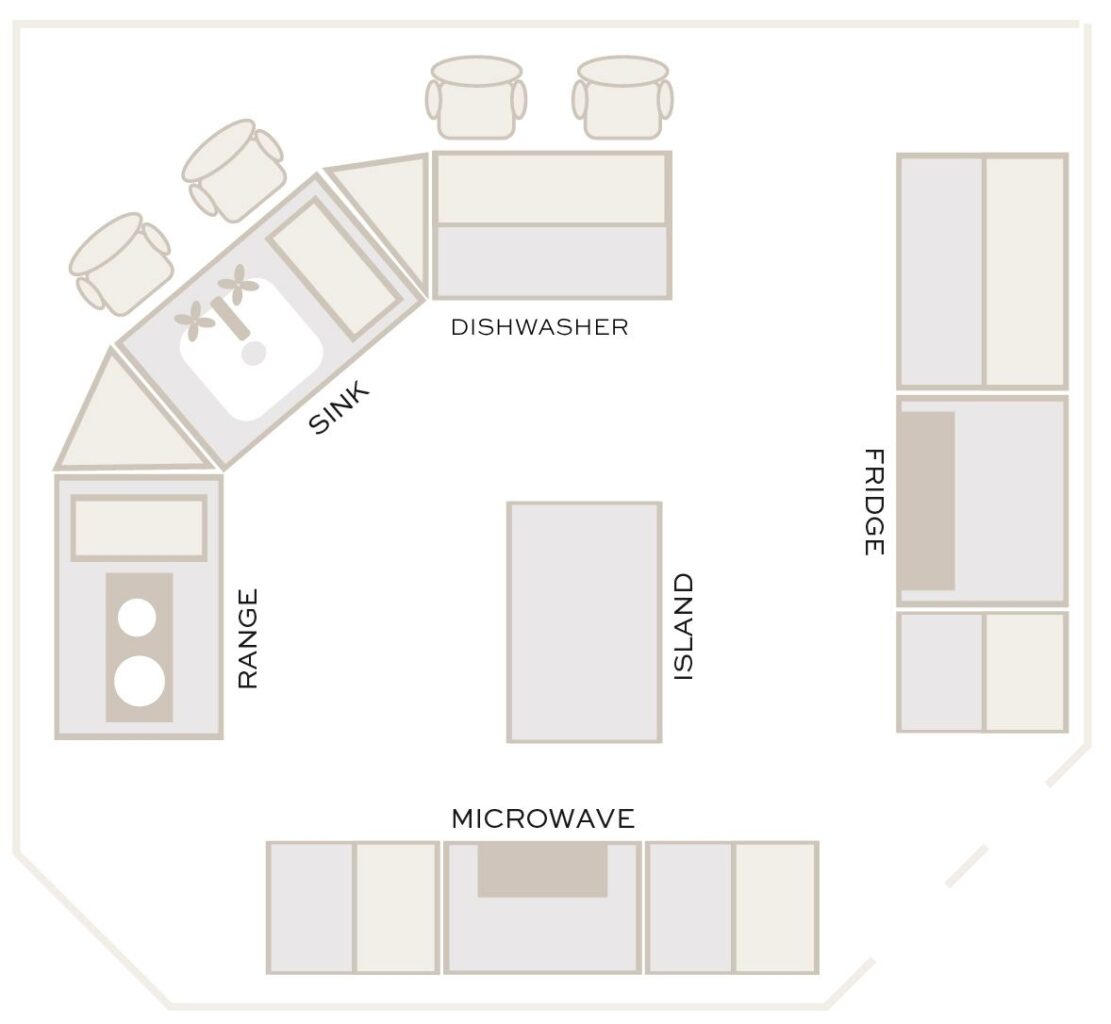
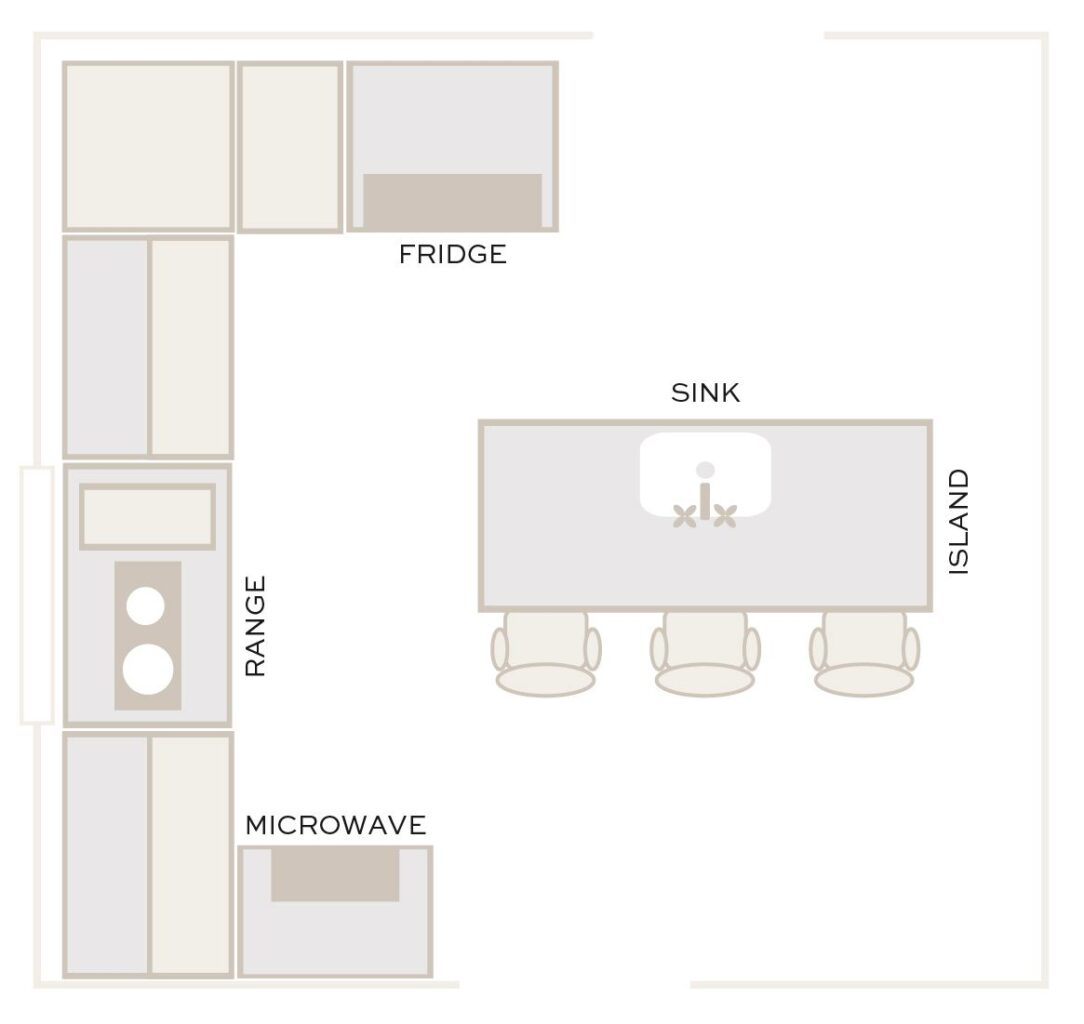
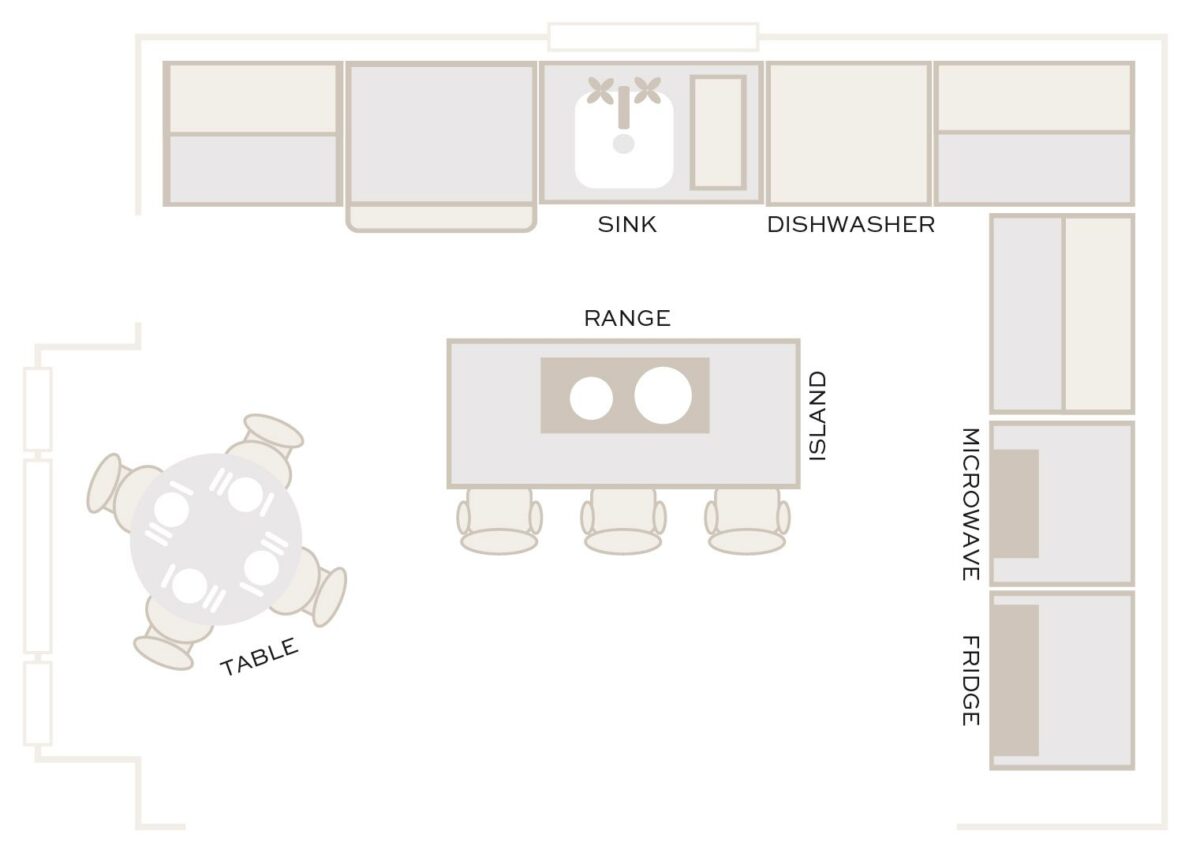
Start with a rough layout drawing of what’s where in your kitchen. You don’t need to be a fancy artist, just draw rectangles with labels if that’s your speed!!
You can use one of our drawings below, too, if they match your layout closely…just change a label or make a note if something is in a slightly different place!

Have your got your drawing? Great! Now let’s dig into the exercise…
Step 1: Pick a collective moment
Choose a time of day when your kitchen is naturally active. That means you and one person (or several) are in the space, or at least moving through.
This might be a weekend morning, dinner prep, an after-school snack time, clean-up after a meal…
Now pause and picture it clearly. Ask yourself:
- Who is in the kitchen?
- What are they each trying to do?
Just take mental note for now…
Step 2: Identify the “zones”
Now, locate the main areas people use in your kitchen. A few extra labels might be helpful, especially if you have a different color you can jot them down in…
Typical functional zones in a kitchen include:
- Sink
- Refrigerator
- Cooktop/oven
- Trash/recycling
- Pantry or food storage
- Prep space (where you actually chop, assemble, or set things down)
Step 3: Follow one person at a time
Start with yourself. “Walk through” what you do during the moment of the day that you chose. For instance, do you come in from buying groceries, then set the bags down on the counter, then move back and forth between the fridge and pantry as you put things away?
Or maybe you stand at the counter and work a little extra on an open laptop while your partner preps dinner, and a son or daughter hovers looking for a snack…
Ask yourself:
- Where do I stop?
- Where do I turn?
- Where do I double back?
Then, draw that “flow” (just yours for now) as a series of arrows on your kitchen layout!!
Step 4: Next, add the second person
This is where things get interesting!! Think about another person who’s in the kitchen at the same time. Now, follow their path the same way. Ask yourself:
- Where do they go first?
- Where do they pause?
- What do they open?
Then, add their path (in another color, preferably) over yours on the kitchen layout.
To get ahead of the next steps, take a moment now to notice…
- Where do your paths cross?
- Where would one of you have to slow down?
- Where would someone say, “hang on” or “excuse me”?
Step 5: Add the “open door” moments
Now, replay that same scene in your head, but this time, imagine everything that opens.
Like…
- The refrigerator door
- The dishwasher
- A drawer
- The oven
- The trash pull-out
Then ask:
- What walking/working space disappears when this is open?
- Does the open door block a walkway?
- Does it trap someone in place?
- Does someone have to wait for it to close?
Step 6: Stack the activity
Finally, imagine it all happening at once.
- You’re prepping
- Someone opens the fridge
- Someone else is at the sink
- The dishwasher is open
And then ask one simple question:
Does everything still work with this layout and movement…or does our kitchen usability start to break down?

If your kitchen feels tight, crowded, or interrupted, that’s not you! It’s your layout.
What have you gotten used to that shouldn’t feel this hard?
Unfortunately, most folks we talk to have NO clue how much they’ve already adapted to their kitchen layout problems…they just accept crowded, annoying, inconvenient routines as they are.
But if you’re frequently waiting, skirting around others, asking people to stay out of the kitchen at specific times…these are NOT habits. They’re unnecessary workarounds that expose kitchen layout problems.
The Simplest Way to Know: The Bottleneck Checklist
If you don’t want to map it all out, this is your shortcut.
Read through the list below and think about your everyday routines. Not special occasions, just a normal morning, or a typical evening, or a weekend when people are in and out.
If any of the following things happen regularly, then your kitchen is working against you.
Keep track of how many of these bottleneck signs are relatable:
- Someone has to step aside so another person can open the refrigerator
- The dishwasher blocks a main walkway when it’s open
- You wait to access the sink because someone else is already there
- The trash or recycling pull-out interrupts prep or movement
- You regularly say “excuse me” while cooking or cleaning
- Two people can’t comfortably work in the kitchen at the same time
- Opening the oven door cuts off circulation through the space
- The pantry or a cabinet door creates a temporary “dead end”
- People naturally gather in a spot that blocks someone else’s task
- You have to reroute your path to avoid someone or something open
- Groceries get set down in the same place every time…and that place is in the way
- Kids (or anyone grabbing snacks) interrupt whoever is cooking
- You delay certain tasks (like unloading the dishwasher) until the kitchen is “clear”
- Carrying dishes, pans, or trays feels like navigating around obstacles
- You’ve adjusted your habits to avoid being in each other’s way
The real test

If you found yourself nodding along to even a few of those bottlenecks, then your layout is TRULY creating unnecessary friction.
The good news is that once you can see these patterns, you’re no longer guessing!! And that’s the first step toward creating a space that feels effortless to live in.
The next step?! Schedule a quick 15-minute Zoom conversation with our team to learn what to DO about the problems you’ve uncovered!!
About the author

Robin Burrill, RID, NCIDQ, ASID, IDS, CAPS, is an award-winning professional kitchen, bath, and interior designer. Robin and her husband, Robert Mathews, have owned Signature Home Services, Inc. for over three decades, establishing a superior in-house team with a widespread reputation for delivering meticulous design to their many repeat clients.
In 2022, the national publication, Kitchen and Bath Design News magazine, named Robin to their Top Innovator list in recognition of her achievements in the field of kitchen and bath design. In 2024, she was named one of the Fall 2024 Market Pros and “tastemakers” by ANDMORE at High Point Market. In 2024 and again in 2025, Fixr identified her as one of the Top Professional Interior Designers for their nationwide audience. At the start of 2025, she then acted as one of Dallas Market’s “Style Eyes” at Lightovation and Total Home & Gift Market.
Over her extensive career, Robin has been quoted in Architectural Digest and Forbes multiple times; her design work has been featured in top national trade publications; and she has been interviewed for Designers Today magazine’s “Profiles in Design” video series, among others. Widely respected for the depth of her knowledge, Robin is a sought after speaker and judge for many design industry events.
In 2023, Robin designed a bench for Charleston Forge, making her foray into product design. Robin currently serves as a volunteer on the board of the Dallas/Ft. Worth chapter of the Interior Design Society.
Leave a Reply